
Where you're staying
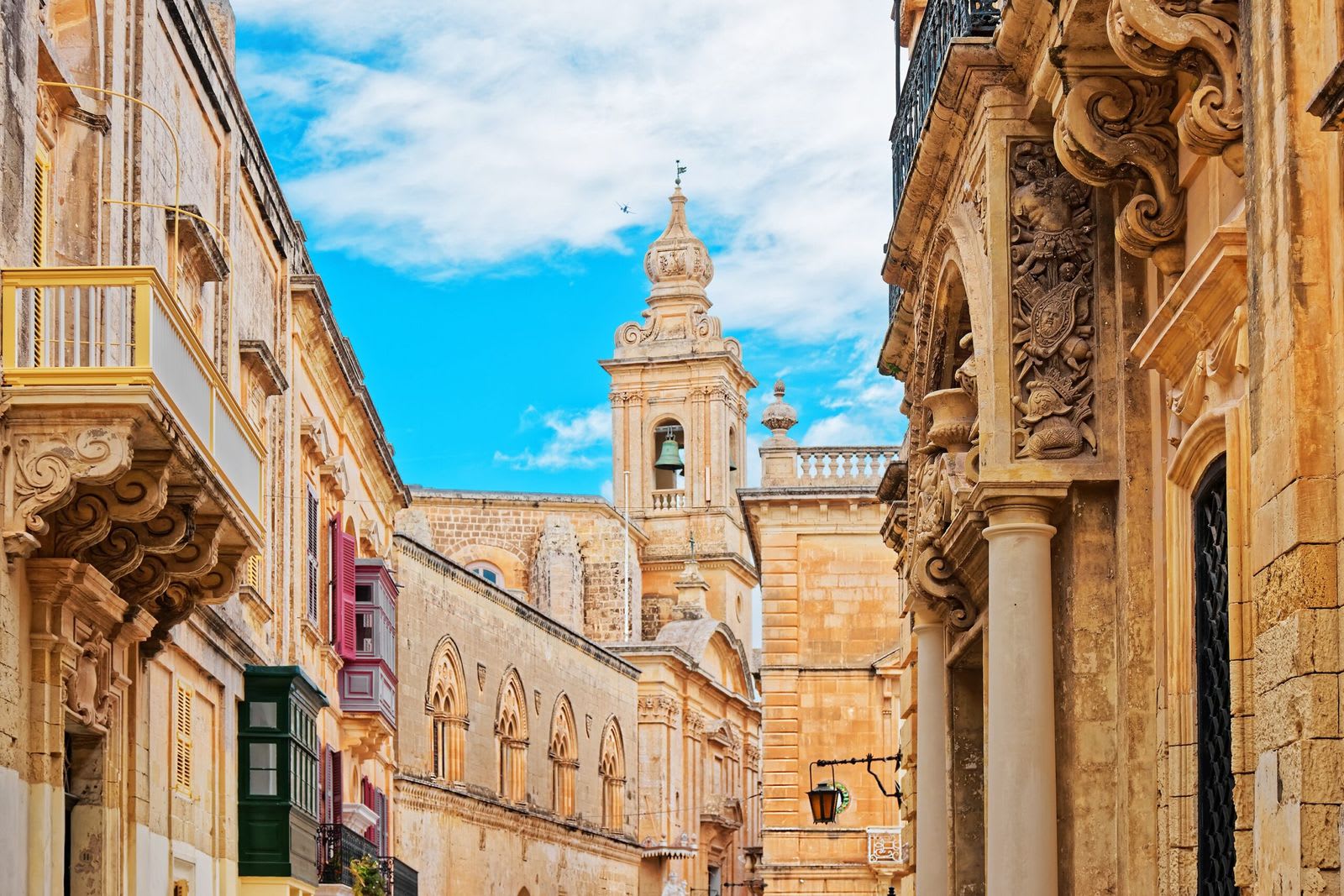
Mdina was Malta's capital for well over a thousand years: Phoenician, Roman, Arab, Norman, and finally the walled baroque city of the Maltese nobility. When the Knights moved the capital to Valletta, Mdina was left behind, and that is exactly why it survives. Fewer than 300 people live inside the walls. Cars are almost entirely banned. By evening it is silent, which is how it earned its name: the Silent City.
Rabat, literally the suburb, grew up outside those walls, and holds a great deal of what Mdina doesn't: the catacombs, the Roman villa, the grotto, and everyday Maltese life.
You are staying in the middle of both.
Inside Mdina
Mdina Gate
The great baroque gateway of 1724, approached across a stone bridge over the ditch. You will recognise it: it stood in for the gates of King's Landing in Game of Thrones. Walk through it slowly the first time.
St Paul's Cathedral
Mdina's cathedral, rebuilt after the 1693 earthquake, with a marble-inlaid floor of tombstones and a remarkable painted dome. The Cathedral Museum alongside holds an important collection, including Dürer woodcuts.
Modest dress required: shoulders and knees covered.
Bastion Square
The viewpoint. From the top of the walls the whole eastern half of Malta lies below you, out to the Grand Harbour and the sea. Best at sunrise or in the last hour of light.
Palazzo Falson
A Norman house of 1495, one of the oldest buildings in Mdina, preserved as the home of the collector who lived here: armour, silver, paintings, books, all of it in place. Small, and quietly excellent.
Mdina Dungeons
The medieval prison chambers beneath the walls. Grim, atmospheric, and popular with older children.
The glass shops and craft studios
Maltese glass, silver filigree and lace are made and sold within the walls. Worth a browse for something that isn't a fridge magnet.
In Rabat
St Paul's Catacombs
An extensive Roman-era underground cemetery, the largest complex of its kind in Malta, in use from the 3rd century AD. Cool, echoing and genuinely impressive. Managed by Heritage Malta.
St Paul's Grotto & the Wignacourt Museum
Tradition holds that St Paul sheltered in this cave after being shipwrecked on Malta in AD 60, the founding story of Maltese Christianity. The adjoining Wignacourt Museum leads down into further catacombs and World War II shelters carved from the rock.
Domus Romana
The remains of a wealthy Roman townhouse, built around a peristyle courtyard and floored with mosaics of real quality. Sitting right on the boundary between Rabat and Mdina.
St Paul's Church & the parish
The heart of Rabat, and the centre of the town's festa in summer.
A walk from our door
An easy half-day, in this order:
- Leave the house and walk up towards the walls
- Domus Romana, start with the Romans
- Through Mdina Gate and into the Silent City
- St Paul's Cathedral, then the Cathedral Museum
- Palazzo Falson, the Norman house
- Bastion Square for the view, and the walk along the walls
- Fontanella for cake on the bastion
- Back out to Rabat for St Paul's Catacombs and the Grotto
- Dinner inside the walls, once the day visitors have gone
When to go
Mdina is at its best early and late. Coach parties arrive mid-morning and are largely gone by five. Before 9:00 AM the streets are empty and the light is beautiful; after 7:00 PM the lamps come on and the city genuinely falls silent.
Staying here is the advantage.
You don't have to visit Mdina, you can step out into it at any hour, which is something day visitors never get to do. Take a walk after dinner at least once.
Further afield
When you've done Mdina and Rabat, the rest of the island is close: Valletta, the Three Cities, Marsaxlokk, the Blue Grotto, the prehistoric temples, and Dingli Cliffs ten minutes up the road.